Different types of metal mesh are ubiquitous in modern life, serving critical functions across a wide spectrum of industries, from construction and agriculture to healthcare and security. This versatile material, formed by interconnecting wires or sheets of metal, provides solutions for filtration, reinforcement, shielding, and containment. Understanding the nuances of these various mesh types – their composition, weave patterns, and properties – is crucial for engineers, designers, and procurement professionals seeking optimal performance and cost-effectiveness. The global demand for metal mesh is consistently growing, driven by infrastructural development in emerging economies and increasing demands for specialized applications.
The significance of different types of metal mesh extends beyond purely industrial applications. In disaster relief scenarios, rapidly deployable shelters utilizing metal mesh frameworks offer immediate protection for displaced populations. Similarly, in humanitarian aid efforts, metal mesh can be utilized in water purification systems and as protective barriers in conflict zones. Its adaptability and durability make it a key component in addressing global challenges, and advancements in material science continue to expand its potential uses. The estimated global metal mesh market size was valued at USD 12.5 billion in 2023 and is projected to reach USD 16.8 billion by 2030.
Ultimately, a thorough understanding of different types of metal mesh empowers informed decision-making. Whether selecting the ideal mesh for a complex engineering project or deploying a life-saving solution in a crisis, knowledge of material properties, manufacturing processes, and industry standards is paramount. This guide explores the diverse landscape of metal mesh, outlining its key features, applications, advantages, and future trends, with a focus on practical considerations and actionable insights. Furthermore, the versatility of metal mesh allows for custom tailoring of materials to address unique needs.
The Core Characteristics of different types of metal mesh
At its core, metal mesh is defined by its interwoven structure, creating openings of varying shapes and sizes. The fundamental characteristics influencing its behavior include the wire diameter, aperture size (the space between wires), and the weave pattern. Different weave patterns, like plain weave, twill weave, and Dutch weave, offer distinct properties – plain weave provides a balanced structure, twill weave enhances flexibility, and Dutch weave excels in filtration due to its tapered apertures. These characteristics are tailored to specific application requirements.
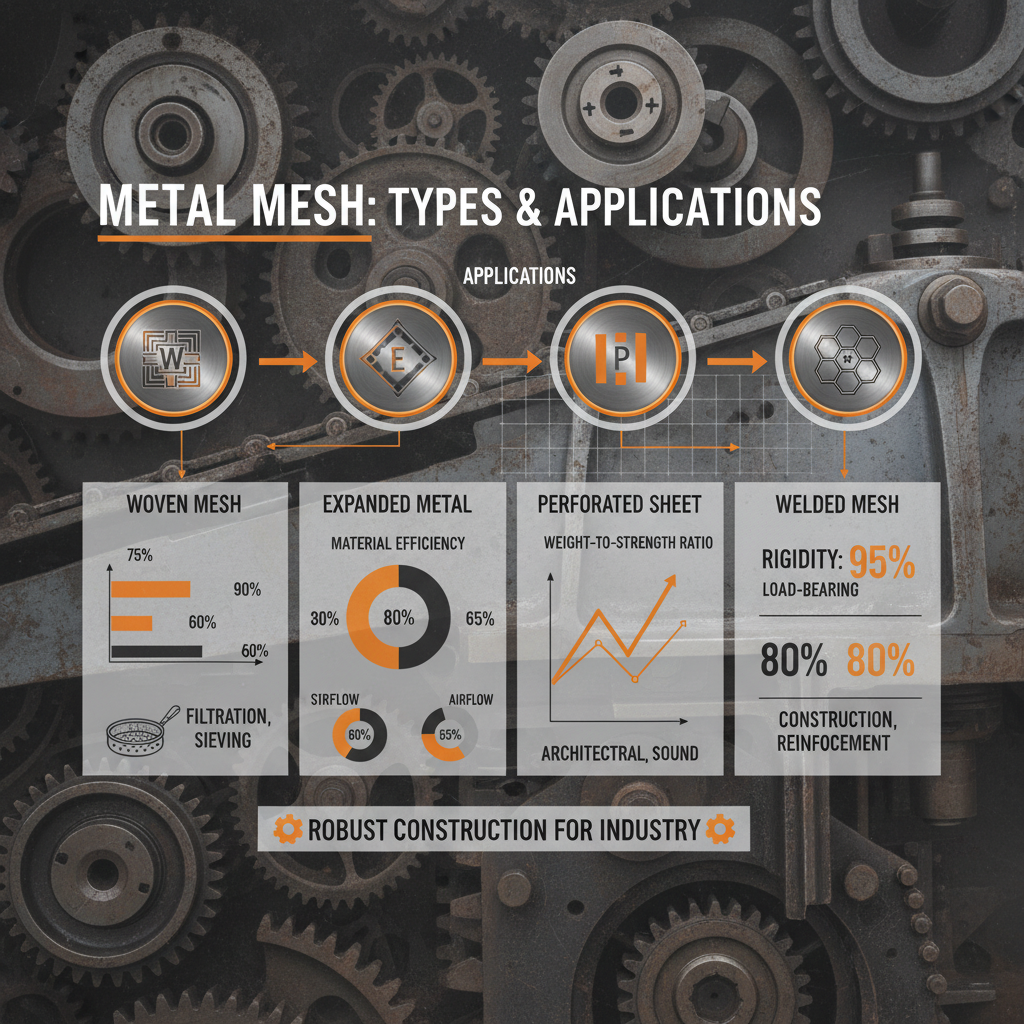
The manufacturing process significantly impacts the final characteristics. Methods such as weaving, welding, and expanding sheet metal each result in different mesh properties. Welded mesh, for example, is renowned for its strength and dimensional stability, while expanded metal mesh offers a unique monolithic structure. Understanding these production techniques is essential for selecting the appropriate type of metal mesh for a given purpose.
Material Composition and its Influence
The selection of the metal itself is a crucial determinant of mesh performance. Stainless steel is a prevalent choice due to its exceptional corrosion resistance and durability, making it suitable for demanding environments. Carbon steel provides high strength at a lower cost, but requires protective coatings to prevent rust. Aluminum is lightweight and offers excellent conductivity, ideal for applications requiring heat dissipation or electrical shielding. Beyond these common materials, specialized alloys like titanium and nickel alloys are employed in high-performance applications demanding extreme temperature resistance or biocompatibility.
The choice of material also impacts the mesh's workability and weldability. Certain alloys are easier to form into complex shapes, while others require specialized welding techniques. Considerations such as operating temperature, exposure to corrosive substances, and load-bearing requirements all guide material selection. The specific grade of stainless steel, for instance, influences its resistance to different types of corrosion.
Furthermore, material composition directly affects the mesh’s weight and overall cost. A careful balance must be struck between performance requirements and budgetary constraints when choosing the most appropriate metal for a given application of different types of metal mesh. Recycled metal content is also increasingly considered for environmentally conscious projects.
Key Properties Defining Performance
Several key properties dictate the performance of different types of metal mesh. Tensile strength – the ability to withstand stretching forces – is critical for applications requiring structural integrity. Yield strength indicates the point at which the mesh begins to deform permanently. Corrosion resistance, as previously mentioned, is paramount in harsh environments. Permeability, the ease with which fluids or gases can pass through the mesh, is essential for filtration applications.
Another important property is aperture size uniformity – consistent openings are vital for precise filtration and screening processes. Mesh count, measured as the number of openings per inch, provides a standardized measure of mesh fineness. Dimensional stability, the ability to maintain its shape under varying temperatures and loads, is crucial for long-term reliability. Flexibility is important in applications requiring conformability or vibration damping.
These properties are often interconnected. For example, increasing the wire diameter generally enhances tensile strength but reduces permeability. Understanding these trade-offs is essential for optimizing mesh selection for specific needs. Material certifications and testing reports are crucial for verifying that the mesh meets required performance standards.
Applications Across Diverse Sectors
The versatility of different types of metal mesh translates into a vast range of applications. In construction, it’s used for reinforcement in concrete, creating composite materials with enhanced strength and durability. In agriculture, metal mesh serves as fencing, netting for crop protection, and support structures for climbing plants. The automotive industry utilizes mesh for radiator grilles, air filters, and catalytic converter components.
The pharmaceutical and food processing industries rely on metal mesh for filtration, separation, and sterilization processes. In aerospace, high-strength, lightweight metal mesh is employed in aircraft components and engine filters. Security applications include perimeter fencing, security screens, and protective enclosures.
Market Share of different types of metal mesh Applications
Advantages and Long-Term Value Proposition
The benefits of using different types of metal mesh are multifaceted. Its durability translates into long service life, reducing the need for frequent replacements and lowering lifecycle costs. The inherent strength-to-weight ratio makes it an ideal material for applications where weight is a critical factor. Its ability to be custom-fabricated allows for tailored solutions that precisely meet specific requirements.
From a sustainability perspective, many metal meshes are fully recyclable, minimizing environmental impact. The use of metal mesh can also contribute to enhanced safety and security in various applications, providing reliable protection and containment. The long-term value proposition stems from its combination of performance, durability, and sustainability.
Emerging Trends and Innovations
Several exciting trends are shaping the future of metal mesh technology. Additive manufacturing, or 3D printing, is enabling the creation of complex mesh geometries with unprecedented precision. The development of new alloys with enhanced properties, such as self-healing metals and shape memory alloys, is expanding the range of potential applications. Smart metal mesh, incorporating sensors and actuators, is emerging as a disruptive technology.
Furthermore, advancements in coating technologies are improving corrosion resistance and enhancing functionality. The integration of metal mesh with other materials, like polymers and ceramics, is creating composite materials with synergistic properties. These innovations promise to unlock new levels of performance and versatility for different types of metal mesh.
Challenges and Future Outlook
Despite its numerous advantages, the use of different types of metal mesh faces certain challenges. Manufacturing costs can be relatively high for specialized mesh types. Ensuring consistent quality control across large-scale production runs is crucial. Addressing the potential for galvanic corrosion when dissimilar metals are used in contact requires careful consideration.
Looking ahead, continued innovation in materials science and manufacturing processes will be essential for overcoming these challenges. Increased adoption of automation and artificial intelligence will drive down costs and improve efficiency. A greater focus on sustainability and circular economy principles will promote the use of recycled materials and minimize waste.
The demand for different types of metal mesh is expected to continue growing, driven by the need for lightweight, durable, and versatile materials across a wide range of industries. The future outlook is bright for this essential material.
Summary of Key Challenges and Mitigation Strategies for different types of metal mesh
| Challenge |
Impact on Performance |
Mitigation Strategy |
Implementation Cost (1-10) |
| High Manufacturing Costs |
Reduced Profit Margins, Limited Accessibility |
Automation, Optimized Production Processes |
7 |
| Quality Control Inconsistencies |
Variable Performance, Increased Failure Rates |
Statistical Process Control, Automated Inspection |
6 |
| Galvanic Corrosion |
Material Degradation, Structural Weakening |
Material Selection, Insulating Coatings |
4 |
| Limited Design Flexibility |
Constraints in Custom Applications |
Additive Manufacturing, Advanced Forming Techniques |
8 |
| Environmental Impact of Production |
Resource Depletion, Pollution |
Recycled Materials, Sustainable Manufacturing Practices |
5 |
| Supply Chain Disruptions |
Delays, Increased Costs |
Diversified Sourcing, Local Production |
6 |
FAQS
Woven metal mesh is created by interlacing wires at right angles, resulting in a flexible and relatively lightweight structure. Welded metal mesh, on the other hand, is formed by joining wires at their points of contact through welding. This results in a more rigid and dimensionally stable mesh. Woven mesh generally offers better drape and conformability, while welded mesh excels in strength and load-bearing capacity. The choice depends on the specific application requirements. Welded mesh is also often more cost-effective for larger surface areas.
Aperture size, the space between the wires, is a critical factor in filtration efficiency. Smaller apertures provide finer filtration, effectively removing smaller particles. However, smaller apertures also increase resistance to flow, potentially reducing the filtration rate. Larger apertures allow for higher flow rates but may allow larger particles to pass through. The optimal aperture size depends on the size of the particles to be filtered and the desired flow rate. It’s a balance between efficiency and permeability.
Mesh count refers to the number of openings (wires) per linear inch of mesh. A higher mesh count indicates a finer mesh with smaller openings. For example, a mesh count of 100 means there are 100 wires per inch. Mesh count is a standardized measurement used to classify the fineness of a mesh and is a crucial factor when selecting the appropriate mesh for specific screening or filtration tasks. It directly correlates to the size of particles that can pass through the mesh.
While stainless steel is inherently corrosion-resistant, certain environments can still cause corrosion. Selecting the appropriate grade of stainless steel for the specific environment is crucial. Consider factors like chloride exposure, temperature, and pH levels. Passivation treatments can enhance corrosion resistance by forming a protective oxide layer. Avoiding contact with dissimilar metals can also prevent galvanic corrosion. Regular cleaning and maintenance can further prolong the life of the mesh.
Sustainability considerations include the use of recycled content in the metal mesh, its recyclability at the end of its life, and the environmental impact of the manufacturing process. Opting for manufacturers with sustainable practices and certifications is important. Choosing durable materials that require less frequent replacement also reduces environmental impact. Evaluating the embodied energy of different mesh types can also inform sustainable purchasing decisions.
Metal mesh is finding increasing applications in renewable energy, particularly in fuel cells as electrode support materials, and as filters in solar thermal collectors. It’s also used in wind turbine blade protection and in the construction of efficient heat exchangers for geothermal energy systems. The lightweight and durable properties of metal mesh make it well-suited for these demanding applications, and ongoing research is exploring even more innovative uses.
Conclusion
Different types of metal mesh represent a cornerstone of modern engineering and industrial applications. From its fundamental characteristics – material composition, weave patterns, and key properties – to its diverse applications across construction, agriculture, aerospace, and beyond, this versatile material offers a unique combination of strength, durability, and adaptability. Understanding these nuances is essential for making informed decisions and optimizing performance in various contexts.
Looking ahead, continued innovation in materials science and manufacturing processes will unlock even greater potential for metal mesh. Embracing sustainable practices, such as utilizing recycled materials and minimizing waste, will further enhance its environmental profile. Visit our website at www.jinzehongwiremesh.com to explore our comprehensive range of metal mesh products and discover how we can help you meet your specific needs.